Activities of the IAPL
The actions of the IAPL, the International Review of Criminal Law (RIDP), IAPL Congresses..
IAPL Actions in favour of Human Rights and International Criminal Justice
The IAPL aims to contribute to the improvement of criminal law through studies conducted by its members, exchanges related to these studies, and the proposals and resolutions it formulates for states and international institutions. Among the numerous actions of the IAPL, it is worth highlighting those in favour of the abolition of the death penalty and international criminal law and international criminal justice.
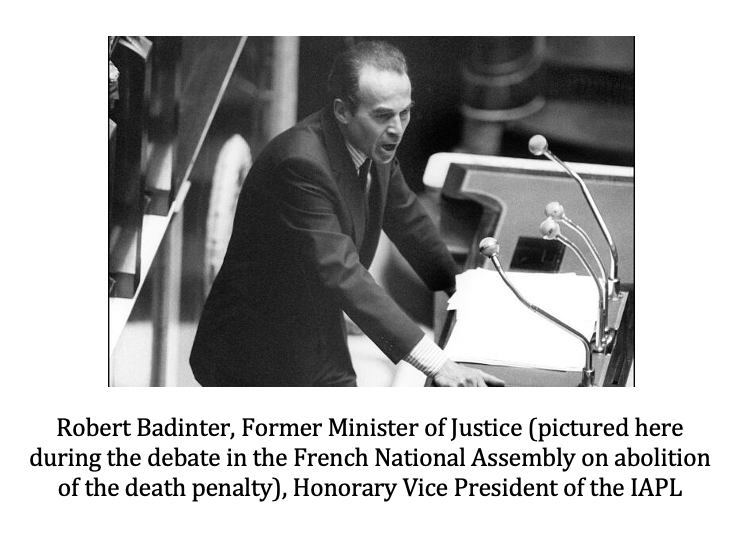
Regarding the abolition of the death penalty, the IAPL has consistently and strongly advocated for it. In 1987, it held a conference on this topic, attended by Mr. Robert Badinter, a member of the IAPL Board and Honorary Vice President of the IAPL. Like Mr. Robert Badinter, many IAPL members have worked in their national capacities for the abolition of the death penalty, thus generalising the abolition of the death penalty in Europe.
Concerning international criminal law and international criminal justice, the IAPL has historically worked towards their development, making it a pioneering institution in this field. This commitment originated from the involvement of several of its founders in this discipline, including Professors Henri Donnedieu de Vabres, Vespasien Pella, and Quintiliano Saldaña. It has been noted that "the founding fathers of the IAPL were particularly devoted to international criminal law." The development of international criminal law and the coordination of rules of criminal procedure and investigation were formally mentioned in the statutes as an objective of the IAPL, which was an innovation and a difference from the UIDP.
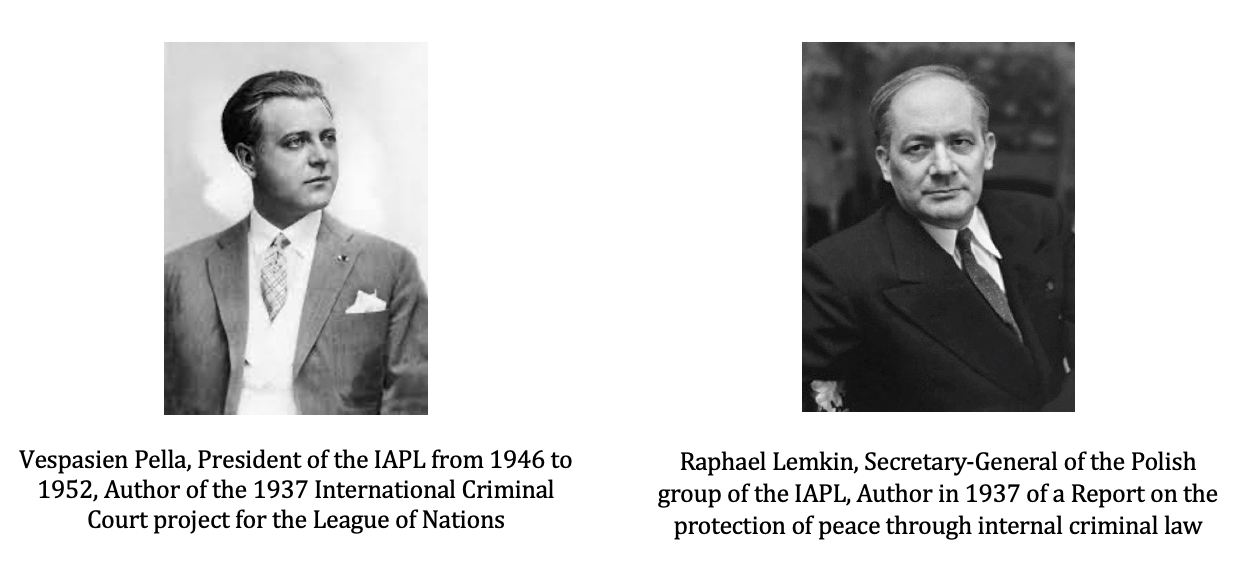
- For international criminal law, the IAPL played a major role in drafting the UN Convention against Torture in 1984, which was adopted following a project drafted by the IAPL Secretary-General and discussed and approved by an IAPL expert committee. It also contributed to the drafting of several UN international cooperation conventions: the convention on offenses and other acts committed on board an aircraft signed in Tokyo on September 14, 1963, the convention for the suppression of unlawful seizure of aircraft signed in The Hague on December 16, 1970, the convention for the suppression of unlawful acts against the safety of civil aviation signed in Montreal on September 23, 1971. The IAPL had also, since 1937, adopted a resolution calling for the creation of the crime of aggression. This innovative resolution was passed during the proceedings of the IVth Congress of the IAPL, which notably focused on international peace. Raphael Lemkin, who later coined the concept of genocide, presented a report on this matter at this Congress.
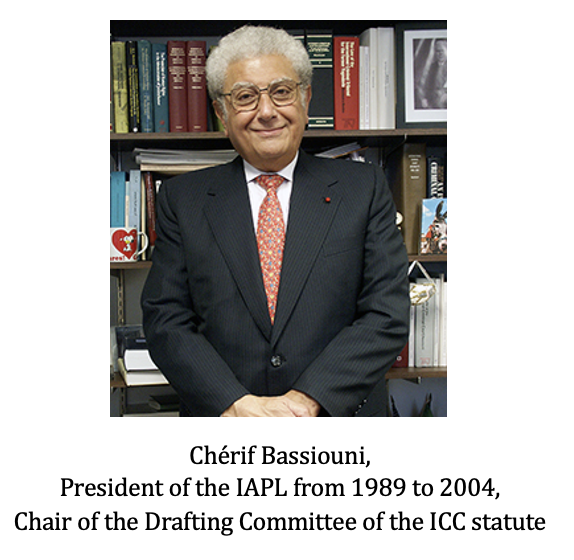
- For international criminal justice, the IAPL initiated a precursor project of the International Criminal Court, drafted by Professor Vespasien Pella in 1928 for a commission set up within the IAPL. The IAPL also initiated the 1937 League of Nations project to establish an international criminal court, written by Vespasien Pella. Henri Donnedieu de Vabres later drafted the first project of the International Criminal Court for the UN. Chérif Bassiouni, President of the IAPL from 1989 to 2004, chaired the Drafting Committee of the statute of the International Criminal Court during the Diplomatic Conference of Rome that adopted this statute.
Concerning international criminal justice, it is worth noting that the IAPL convened on May 18, 1946, at the IMT headquarters in Nuremberg, at the initiative of Professor Henri Donnedieu de Vabres, French judge at the IMT. This meeting was chaired by Mr. Francis Biddle, an American judge at the IMT. Its purpose was to reactivate the IAPL, whose activities had been interrupted by the war, and symbolically mark this reactivation under the sign of the new criminal law established in Nuremberg.
Throughout its history, the IAPL has been a major player in the promotion of international criminal justice through the establishment international criminal tribunals.
It should be noted that the IAPL was accredited as a non-governmental organization (NGO) with consultative status at the UN in 1950 and as an observer with the Council of Europe in 1970. These accreditations attest to the international recognition of the IAPL as an organisation committed to the universal improvement of criminal law and criminal justice.

International Review of Criminal Law (RIDP)
The creation of the IAPL was accompanied by the creation of the International Review of Criminal Law (RIDP), the first issue of which was published in 1924 and contains copies of the acts establishing the IAPL.
The RIDP continues to be published twice a year.
The RIDP publishes the reports presented at the preparatory colloquia for the IAPL Congresses, as well as the proceedings of these Congresses. It also publishes studies in all fields of criminal law, with a predominance for international criminal law and comparative criminal law.
IAPL Congresses
The IAPL regularly organises congresses where it brings together all its members to discuss a specific theme identified during the previous congress. Initially, these congresses did not have a specific theme and addressed very different questions. However, there is a consistency in themes related to international criminal law and international criminal justice from the early congresses of the IAPL. The issue of establishing an international criminal court was on the agenda of the first IAPL congress in Brussels in 1926. It decided to set up a committee to draft a project for the International Criminal Court. This draft statute was published in the RIDP issue of 1928. All subsequent congresses examined at least one question of international criminal law or international criminal justice.
The current IAPL Congresses focus on a specific general theme determined at the previous Congress and are articulated around the four main branches of criminal law: general criminal law, special criminal law, criminal procedure, and international criminal law. Preparatory colloquia take place between two congresses and aim to prepare the theme of the next congress. These preparatory colloquia break down this theme into four sections: section 1 deals with the theme in relation to general criminal law, section 2 in relation to special criminal law, section 3 in relation to criminal procedure, and section 4 in relation to international criminal law.
The proceedings of the Congresses are published in the RIDP.
Annexes
HIstory of IAPL Congresses (year, number, main theme, and location)
- 1926: 1st Congress, Report on the current legislative state, Brussels
- 1929: 2nd Congress, Corporate liability, Bucharest
- 1933: 3rd Congress, Which offenses should be subject to universal jurisdiction?, Palermo
- 1937: 4th Congress, How can domestic criminal law contribute to the protection of international peace?, Paris
- 1947: 5th Congress, How can a State, through its internal legislation, contribute to ensuring the peace of another State?, Geneva
- 1953: 6th Congress, Protection of international humanitarian conventions, Rome
- 1957: 7th Congress, Modern orientation of the concepts of the offender and participation in the offense, Athens
- 1961: 8th Congress, Unintentional offenses, Lisbon
- 1964: 9th Congress, Offenses against sexual morality, The Hague
- 1969: 10th Congress, Endangerment offenses, Rome
- 1974: 11th Congress, Evolution of methods and means of criminal law, Bucharest
- 1979: 12th Congress, Offenses committed through negligence. Prevention and treatment of offenders, Hamburg
- 1984: 13th Congress, Omission offenses, Cairo
- 1989: 14th Congress, Legal and practical problems posed by the difference between criminal law and criminal administrative law, Vienna
- 1994: 15th Congress, Environmental offenses. Problems of general criminal law, Rio de Janeiro
- 1999: 16th Congress, Criminal justice systems in the face of organized crime, Budapest
- 2004: 17th Congress, Criminal responsibility of minors in domestic and international order, Beijing
- 2009: 18th Congress, Widening of preparatory forms and participation, Istanbul
- 2014: 19th Congress, Information society and criminal law, Rio de Janeiro
- 2019: 20th Congress, Criminal Justice and Corporate Business, Rome
List of IAPL Presidents (term duration, name, country, profession or position)
- 1924-1945: Henry Carton de Wiart (Belgium), Minister of State of Belgium
- 1946-1952: Vespasien V Pella (Romania), Professor at the University of Bucharest
- 1953-1962: Paul Cornil (Belgium), Professor at the Free University of Brussels
- 1963-1969: Jean Graven (Switzerland), Professor at the University of Geneva
- 1969-1979: Pierre Bouzat, (France), Professor at the Faculty of Law of Rennes
- 1979-1989: Hans-Henrich Jeschcek (Germany), Professor at the University of Freiburg
- 1989-2004: Chérif Bassiouni (Egypt-United States), Professor at De Paul University
- 2004-2014: José Luis De La Cuesta (Spain), Professor at the Faculty of Law of San Sebastian
- 2014-present: John A. Vervaele (Belgium), Professor at the University of Leiden
Share this page